
In Dubai, washing machine drums stop spinning mainly because the city’s hard water carries high levels of dissolved calcium and magnesium. Every single wash cycle deposits a thin layer of these minerals on the internal components of the machine. Over months and years, those layers accumulate into thick limescale that seizes drum bearings, blocks drain pumps, starves the motor of smooth mechanical movement, and triggers safety sensors that shut the spin cycle down completely. The root cause is not the machine. It is the water.
Need Fast Appliance Repair Dubai?
Need fast appliance repair Dubai services you can trust? At proappliancedubai, we provide quick and reliable solutions for all home appliances, including washing machine repair Dubai, fridge repair Dubai, and dishwasher repair Dubai, ensuring same-day support and expert technicians to restore your appliances efficiently and affordably.
What Makes Dubai’s Water So Hard on Appliances
Dubai’s water supply is unlike what most people experience in other parts of the world. Nearly all of it originates from the Arabian Gulf through large-scale desalination plants operated by the Dubai Electricity and Water Authority. During the desalination process, seawater is stripped down and then re-mineralised before it reaches residential taps. That remineralisation step is what introduces calcium and magnesium back into the supply, pushing hardness levels into a range that most appliance manufacturers simply do not design for as a daily baseline.
What makes this particularly challenging for washing machines is the combination of factors unique to this environment. Dubai homes run the air conditioning almost year-round, which means the internal temperature difference between cold incoming water and a heated wash cycle is quite dramatic. Hard water minerals precipitate out of solution most aggressively when water temperature changes sharply. A machine cycling between cold fills and 60 degree wash programmes in a 22 degree conditioned apartment is essentially running a mineral precipitation experiment dozens of times a week, inside a sealed metal drum.
Add to this the sand and fine particulates that are common in Dubai’s atmosphere and occasionally enter the water supply through storage tanks in older buildings. These particles mix with mineral deposits inside the machine and create an abrasive slurry that accelerates wear on every moving part the water touches.
The Exact Mechanism: How Limescale Stops the Drum
Understanding why the drum specifically stops spinning requires understanding what happens inside the machine at a mechanical level, not just a chemical one.
The Bearing Assembly Takes the Worst of It
The drum bearing is a precision component. It is essentially a ring of steel balls sitting inside a lubricated housing, and its entire job is to allow a heavy drum full of wet laundry to spin at several hundred rotations per minute with minimal friction. The tolerances in that bearing are measured in fractions of a millimetre.
Hard water reaches the bearing through the drum seal, which is a rubber ring designed to keep water inside the tub. Over time, mineral-laden water works its way past or around this seal, and when it evaporates, it leaves calcium deposits behind. These deposits build up inside the bearing housing, contaminate the lubrication, and create irregular friction. The drum starts to make a low rumbling or grinding sound during spin cycles, which most residents ignore or attribute to an uneven load.
What is actually happening is that the bearing is fighting through increasing resistance on every rotation. Eventually the friction becomes severe enough that the motor’s thermal protection activates, the machine detects the excess electrical draw, and the spin cycle aborts. The drum does not seize overnight. It degrades over months, and by the time it stops entirely, the bearing has usually been compromised for a considerable period beforehand.
Blocked Drain Pumps Prevent Spin from Starting
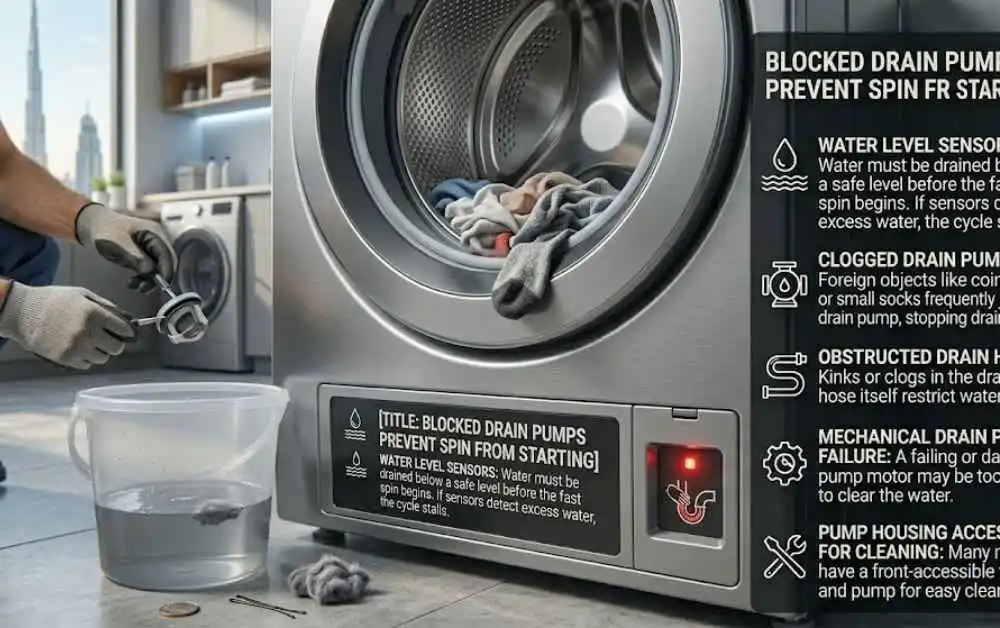
Modern washing machines are designed with a logical sequence: wash, drain, then spin. If the drain cycle does not complete successfully, the machine will not proceed to spinning. This is a deliberate safety design, because spinning a drum full of water would create violent imbalance and could damage the machine or shake it across the floor.
In Dubai’s hard water conditions, the drain pump filter becomes one of the most commonly neglected failure points. This filter catches lint, debris, and small items before they enter the pump mechanism. In hard water environments, it also collects a compacted mixture of limescale and soap scum that builds into a solid blockage surprisingly quickly. A completely blocked filter prevents water from draining, so the machine simply sits with a full tub and never advances to the spin phase. Many residents assume the spinning mechanism has failed when in fact the drain system is the issue.
The Motor Runs Under Escalating Load
A washing machine motor does not fail suddenly in most hard water cases. It fails progressively. As limescale builds on drum surfaces, increases bearing friction, restricts water flow through internal channels, and forces the heating element to work harder to reach the target temperature, every component demands more electrical energy. The motor, which drives the drum’s rotation, operates under this consistently elevated load day after day.
Motor windings overheat under sustained excess load. Carbon brushes in brush-type motors wear down faster. In inverter motor designs, the control electronics begin to generate error codes as current draw exceeds expected parameters. Eventually the motor either burns out completely or the control board registers a fault and permanently disables the spin function until a technician resets or replaces the relevant component.
Sensors Send False Signals When Coated in Minerals
Contemporary washing machines rely on a network of sensors to manage the wash cycle. There is a pressure sensor that reads water level, a temperature sensor on the heating element, hall-effect sensors that monitor drum rotation speed, and in many front-loading machines, a vibration sensor that detects imbalance during spin.
When mineral deposits coat a pressure sensor, it no longer reads water level accurately. The machine may think the tub is still full when it is actually empty, or vice versa. A coated vibration sensor may misread normal drum movement as dangerous imbalance and trigger the automatic spin shutdown that is intended to protect the machine from a genuinely problematic load.
These sensor-related failures are among the most frustrating because they produce no obvious physical symptom. The drum itself may be in reasonable condition, the belt may be intact, the bearings may still have some life left, but the machine simply stops spinning because a calcium-coated sensor is sending the control board the wrong information.
Why Dubai Residents Experience This Faster Than They Should
The typical guidance in washing machine owner manuals is based on water hardness levels found in Western Europe and North America. Recommended descaling frequency in those markets is often every three to six months. For Dubai residents using the machine daily for a household of four or more people, that guidance is dangerously conservative.
In households with young children, where multiple loads run every day across hot cotton cycles and quick synthetic programmes, limescale accumulation inside the machine can reach critical levels within twelve to eighteen months without any maintenance. Many residents do not discover the problem until the drum stops spinning entirely, at which point multiple components typically require attention simultaneously.
The building water storage factor compounds this. Many residential towers in Dubai have large rooftop tanks where treated municipal water sits and is further warmed by the sun before reaching apartment taps. This warming causes additional mineral precipitation in the supply itself before water even enters the washing machine. Residents on higher floors, where the tank is directly above, often experience faster appliance degradation than those in comparable buildings with ground-level storage.
What You Will Notice Before the Drum Stops Completely
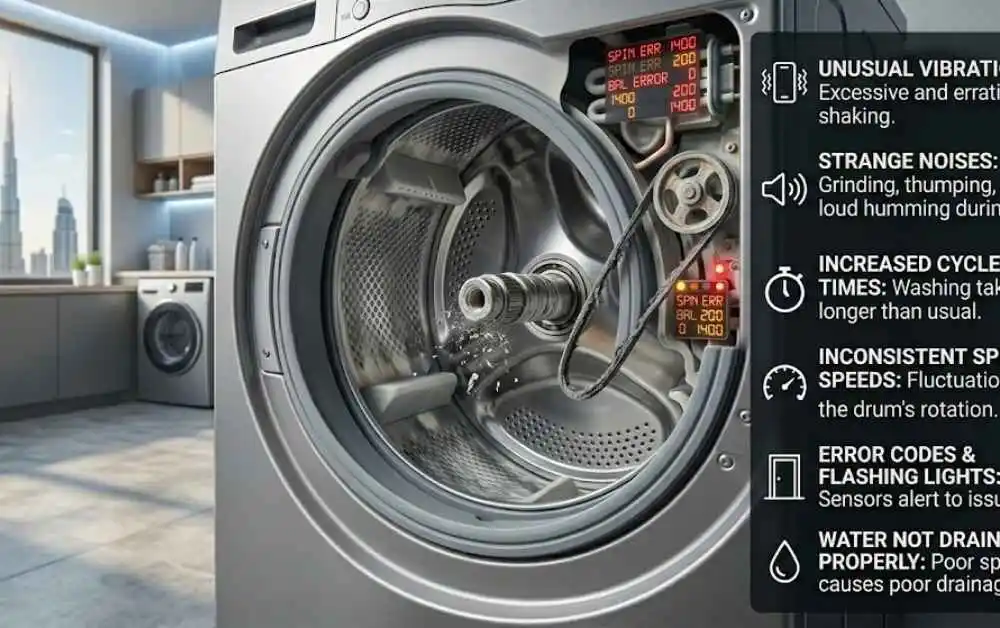
The drum rarely fails without warning. Paying attention to these early indicators can prevent a straightforward maintenance situation from becoming an expensive repair.
The first signal most people notice is an unfamiliar sound during the spin cycle. It usually begins as a faint rumble or low hum that was not present when the machine was newer. This is early bearing wear and it almost always gets worse, never better, without intervention.
Clothes coming out wetter than they used to at the end of a cycle is another significant indicator. If a machine that previously produced nearly dry laundry after a full spin is now leaving clothes noticeably damp, the drum is not reaching its rated spin speed. This performance loss happens because increased mechanical resistance from mineral damage prevents the motor from driving the drum to the full RPM required for efficient water extraction.
Longer cycles are also a common early symptom. When limescale builds on the heating element, the water takes longer to reach the target temperature. The control board extends the heating phase to compensate, making the overall cycle run well beyond the displayed programme time. What appears to be a software glitch is frequently a scaled heating element in early stages of failure.
Vibration during spin that is more aggressive than the machine used to produce points to bearing wear, as an imperfectly spinning drum creates irregular forces that travel through the machine frame. Some residents mistake this for an uneven floor or an overloaded drum, and while those can cause vibration, mineral-related bearing wear produces a characteristic persistent vibration that occurs even with small, evenly distributed loads.
Effective Prevention Strategies Specific to Dubai Conditions
Prevention in Dubai’s environment requires a more aggressive approach than the generic advice found on appliance manufacturer websites.
Running a hot maintenance wash with a citric acid descaler every three to four weeks rather than the standard quarterly recommendation makes a measurable difference in limescale accumulation rates. Citric acid is highly effective at dissolving calcium deposits and is safe for machine components when used at correct concentrations. White vinegar works in a similar way and is more easily available in local supermarkets, though it is slightly less potent against heavy mineral buildup.
Choosing a washing programme temperature deliberately also helps. While high-temperature cycles are sometimes necessary, running every load at 60 degrees or above significantly accelerates mineral precipitation inside the drum and on the heating element. Using 30 or 40 degree programmes for lightly soiled everyday loads reduces this effect considerably without compromising cleaning results on typical laundry.
Cleaning the drain pump filter monthly rather than quarterly is appropriate for Dubai’s water conditions. This takes less than ten minutes and prevents the blocked drain scenario that stops the drum from reaching the spin phase. Most front-loading machines have a small access panel at the bottom front behind which the filter sits. Turning it anti-clockwise releases it, and the accumulated debris and mineral buildup can be rinsed away under a tap.
A whole-home water softener connected to the mains supply is the most comprehensive long-term solution. Ion exchange softeners replace calcium and magnesium ions with sodium, effectively converting hard water to soft before it reaches any appliance. The upfront investment is recouped over time through reduced appliance repair costs, lower detergent consumption, and extended machine lifespans. For families with multiple water-using appliances who plan to remain in the same property for several years, this is the most cost-effective option available.
👉🏻Discover More About Unique Information [How to Find Reliable Appliance Repair Technicians in Dubai ]
Frequently Asked Questions
How do I know if my drum stopped spinning because of hard water damage or an electrical fault?
If the drum stopped working gradually, with increasing noise, reduced spin speed, and longer cycles preceding the complete failure, hard water damage to mechanical components is the most likely cause. If the drum stopped suddenly with no prior warning and the machine displays an error code, an electrical fault or sensor failure is more probable. A qualified technician can distinguish between these causes during a diagnostic visit, though in Dubai’s conditions the two causes are often interrelated because mineralised sensors trigger electrical errors.
Can descaling revive a drum that has already stopped spinning?
Descaling can resolve a spin failure caused by a blocked drain pump or a mineral-coated sensor. It cannot repair physical mechanical damage such as a worn bearing, a seized shaft, or a broken drive belt. If the drum was making noise for several weeks before stopping, the mechanical components likely need hands-on repair rather than a cleaning treatment.
Does the brand of washing machine affect how quickly hard water causes problems?
Yes, meaningfully so. Machines with stainless steel drum surfaces resist mineral adhesion better than machines with coated plastic or cheaper steel. Front-loaders with self-cleaning drum seal programmes and auto-descale features accumulate limescale more slowly. However, no washing machine is immune to Dubai’s water conditions if maintenance is neglected. Even premium European brands with anti-scale technology will develop spin problems within a few years without regular descaling in this environment.
Is it worth repairing a drum that stopped spinning, or better to replace the machine?
This depends on the age of the machine and which component failed. A bearing replacement on a machine that is three or four years old, with no other faults, is usually worth the cost. If the motor has burnt out and the machine is older than seven years, the economics often favour replacement, particularly because the other hard water-affected components are likely approaching failure as well. A technician’s assessment of the full internal condition should inform this decision.
Why does the drum sometimes spin on a short cycle but fail on a full cycle?
Short cycles typically run at lower RPM and for less time, placing less demand on the bearing and motor. Full spin cycles run at higher revolutions for extended periods, generating more heat and requiring more sustained motor output. In a machine with early mineral damage, the components can handle light demand but fail under the sustained stress of a complete high-speed spin. This intermittent behaviour is a strong indicator that the bearing or motor is partially compromised and will deteriorate to complete failure without repair.
How often should washing machines be professionally serviced in Dubai?
Given the water conditions, an annual professional inspection is appropriate for machines used daily in a household of three or more. This service should include descaling of the heating element and drum, cleaning the drain pump and associated filters, inspecting the door or lid seal, checking the drive belt for wear, and testing sensor accuracy. Many repair issues that result in drum spin failures are detectable during such inspections at a stage when the repair is still straightforward and inexpensive.
Conclusion
Washing machine drum failures in Dubai are not random events or signs of poor product quality. They are the predictable result of hard water chemistry interacting with mechanical and electrical components that were not designed for this specific mineral environment. The calcium and magnesium in Dubai’s water supply systematically attack every part of the machine that water touches, from the bearings that allow the drum to rotate freely to the sensors that regulate the entire wash cycle. Understanding this as a water quality issue rather than simply an appliance problem changes how residents approach both prevention and repair.
The good news is that this damage is almost entirely preventable with consistent and appropriately frequent maintenance. Monthly filter cleaning, regular descaling with citric acid or vinegar-based products, thoughtful temperature selection for routine loads, and annual professional servicing go a long way toward extending machine lifespan well beyond what Dubai’s water conditions would otherwise allow. Residents who treat appliance care as a routine part of household maintenance, rather than something to address only when a machine breaks, consistently get far more reliable and cost-effective results from their washing machines in this uniquely demanding environment.